Radical Roots and Revolution
As the United States prepares to celebrate its Semiquincentennial, the 250th anniversary of the signing of the Declaration of Independence, global attention is converging on Philadelphia's history. The cobblestone paths of Independence National Historical Park, the iconic silhouette of Independence Hall, and the ringing ideals of 1776 are the undisputed centerpieces of this milestone year.
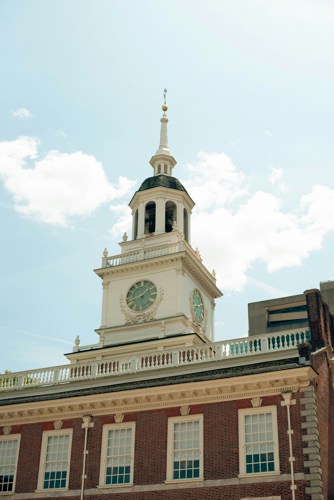
Yet, the true narrative of early America extends far beyond the brick borders of Center City. To fully understand the philosophical currents that fueled the American experiment, one must look just a few miles southwest to the rolling hills and quiet valleys of Delaware County, specifically the historic enclave of Swarthmore. Together, these two spaces represent two sides of the same coin: the political forge of a new nation, and the radical cultural values that sustained it.
The Quaker Experiment: The Foundation Preceding the Revolution
Long before Thomas Jefferson penned the Declaration of Independence in 1776, the foundational identity of Pennsylvania was established by William Penn in 1682. Seeking a refuge from religious persecution, Penn established his "Holy Experiment" on a radical proposition: a society built upon religious tolerance, pacifism, and the revolutionary idea that all individuals possess an "inner light" of equal worth.
This Quaker ethos did more than just attract European settlers; it established the unique ideological climate of southeastern Pennsylvania. It created an environment where dissent was tolerated, education was prioritized, and human rights were debated with an intensity found nowhere else in the colonies.
While Philadelphia became the bustling economic and political epicenter where these ideas were codified into law, the surrounding countryside served as the quiet vanguard practicing these ideals daily.
Swarthmore and the Intellectual Frontier
As the nation grew through its first century, the need to preserve and evolve these founding principles became paramount. In 1864, as the American Civil War tore the fabric of the nation apart, a group of progressive Quakers sought to build an institution that would look toward a reconstructed future. They founded Swarthmore College, named after Swarthmoor Hall in England, the 17th-century birthplace of the Quaker movement.
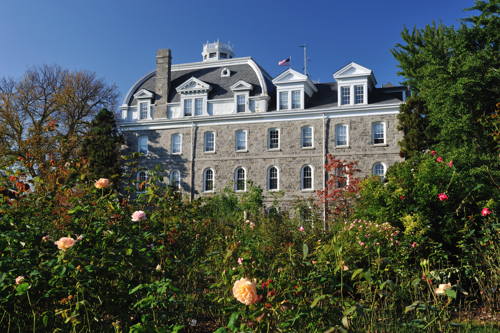
Swarthmore quickly emerged as a critical frontier for the evolving American identity. It was one of the earliest coeducational colleges in the United States, asserting that women deserved the exact same rigorous, high-level education as men, a deeply radical stance for the era. The community became an incubator for social reform, deeply intertwined with the abolitionist movement, the Underground Railroad, and the later fight for women's suffrage led by notable alumni like Alice Paul (Class of 1905).
Two Landscapes, One Heritage
When observing the region through the lens of America's 250th anniversary, the connection between Philadelphia and Swarthmore becomes a compelling historical continuum:
-
The Evolution of Liberty: Philadelphia gave the world the framework for political liberty through the Constitution. Swarthmore helped expand the definition of liberty to include social, intellectual, and gender equality.
-
The Architecture of Time: Center City offers the preservation of early American urban life, while the protected landscapes of Swarthmore, including the expansive Scott Arboretum and the ancient Crum Woods, preserve the pristine natural heritage of the Delaware Valley as it existed when the Lenni Lenape and early settlers walked it.
-
The Shared Spirit of Dialogue: The same spirit of rigorous debate that occupied the assembly rooms of the Pennsylvania State House lives on in the seminar rooms and village spaces of Swarthmore, where the pursuit of truth remains a foundational collective goal.
Experiencing the Full Arc of History
Celebrating America’s 250th anniversary means moving beyond the static textbook definitions of our history. It requires exploring the interplay between the grand, historic stages where documents were signed, and the local, values-driven communities that brought those documents' promises closer to reality.
As the nation reflects on two and a half centuries of progress, the journey through southeastern Pennsylvania remains an essential pilgrimage. A chance to witness where the American identity was legally born, and where its soul continues to be nurtured.